For weeks we asked NYSDEC one plain question. The Oak Orchard permit gives mercury a hard, enforceable number on the industrial outfall. It gives PFOA and PFOS only an action level on the same outfall, the same receiving water, the same units. Why?
Said Yes. Put It in Writing. Then Admitted the Opposite.
That question had a target. Long before we asked it, the claim that this permit protects you was already circulating — in three different forms, from the people responsible for the permit. Set them side by side. Every quote below is from an official source.
Asked at the County Environmental Protection Committee whether the permit for Micron’s discharge has enforceable PFAS limits, Director Dereth Glance answers: yes.
The action levels for PFOA and PFOS are “an enforceable level that requires the permitees to investigate and mitigate” anything above the trigger.
The Department is “not required to establish enforceable effluent limitations for PFOA or PFOS in this permit.”
Yes, an action level is “enforceable.” But read what is actually enforceable: you investigate, you mitigate, you report. That is it. Nothing caps how much PFAS Micron can send into the river. An “enforceable level” that only makes you file forms is not a limit — and DEC’s own July 3 letter says exactly that.
Smoke and Mirrors, Forwarded in Good Faith.
Document two did not surface on its own. The County Executive was handed a written explanation of this permit — the County’s own response to residents, prepared with DEC input — and forwarded it as reassurance. Read the two sentences it leans on.
“Action levels are established as an enforceable level that requires the permitees to investigate and mitigate any levels above the established limits.”
“Pretreatment limits will be put in place with Micron… and ensure that final discharges meet SPDES limits and are safe for human health and the environment.”
Both sentences run the same play. The first calls the action level “an enforceable level” — and what it actually makes enforceable is investigating, mitigating, and reporting, never a cap on how much PFAS is discharged. The second promises protection entirely in the future tense: limits “will be put in place,” a pretreatment permit that “will be established.” Nothing is written and binding today. That is the smoke and mirrors — a page that sounds like protection and commits to none. The official who forwarded it was not deceiving anyone; he was handed it and believed it. That is precisely how a permit with no enforceable PFAS limit gets passed along as one that protects you.
“The Remaining 38” Is Built to Sound Like Everything.
The same County response reassures residents that the permit “requires monitoring and reporting for the remaining 38” PFAS compounds, “consistent with guidance released in USEPA memos (2022).” Two action-level compounds plus thirty-eight monitored ones makes forty — and forty is quietly offered up as the whole of PFAS.
It isn’t. Forty is the exact target list of EPA Method 1633, the method those 2022 memos point to. There are thousands of PFAS compounds. Cornell’s non-targeted analysis of semiconductor fab wastewater identified 133 of them (Jacob et al., Environmental Science & Technology, 2021) — and the compounds a modern fab actually discharges, the short-chain and precursor PFAS, are precisely the ones Method 1633 captures poorly or misses entirely. A 40-compound list drawn from a general 2022 guidance memo was never built for semiconductor effluent.
So “monitoring the remaining 38” is not monitoring everything. It is monitoring forty of at least 133 known fab compounds, with a method that misses most of what comes down the pipe. The word “remaining” does the same work “enforceable” does: it makes a fraction sound like the whole.
On July 3, 2026, Region 7 Director Dereth Glance answered our mercury question in writing. We are posting her letter in full, because it is a public record and because the answer matters. It does not close the gap this campaign has been pointing at. It confirms it — on state letterhead.
“What is the technical or legal distinction that justifies a hard enforceable number for mercury and only a discretionary action level for PFAS.”
First, the permittee is obligated to meet all terms and conditions of the Oak Orchard SPDES permit (NY0030317). Both the permit limits and action levels are enforceable, and failure to comply with these requirements may result in appropriate DEC enforcement action.
Secondly, the use of the different terms, “Water Quality Standard” and “Guidance Values,” stems from where in the applicable regulatory framework these values are established. In New York State, mercury discharge in water is regulated by the Water Quality Standard in 6 NYCRR 703.5, while PFOA and PFOS discharges in water are covered by Guidance Values in Technical Operational Guidance Series 1.1.1.
For mercury, New York State established a numeric water quality standard for the protection of human health from fish consumption in 6 NYCRR 703.5. For the Oak Orchard SPDES permit, DEC conducted a reasonable potential analysis that found the discharge has reasonable potential to exceed the applicable mercury numeric standard. As a result, the SPDES permit is required to include an enforceable mercury water quality-based effluent limitation…
For PFOA and PFOS, New York established water quality guidance values for the protection of aquatic life for both acute and chronic exposure in TOGS 1.1.1. Guidance values are the numeric interpretation of a narrative water quality standard. Based on the reasonable potential analysis conducted using those guidance values, the discharge does not demonstrate reasonable potential to exceed the applicable aquatic life guidance values. Consequently, the Department is not required to establish enforceable effluent limitations for PFOA or PFOS in this permit.
Although enforceable limits are not required, DEC included enforceable action limits in the Oak Orchard SPDES permit consistent with ongoing statewide efforts to minimize PFAS discharges… The Oak Orchard SPDES permit includes action levels for PFOA and PFOS that provide a basis for the publicly owned treatment works (POTW) to:
- establish and implement enforceable local limits for industrial users under its pretreatment program to control PFOA and PFOS dischargers at their source,
- ensure low concentrations PFAS and PFOS in the discharge,
- monitor performance, and
- identify potential increases that may warrant additional evaluation or operational changes.
— Dereth Glance, Director, Region 7
DEC’s own footnote, defining the term: “Action Level means, when used in a SPDES permit, a monitoring requirement characterized by a numerical value that, when exceeded, triggers additional permittee monitoring and department review to determine if numerical effluent limitations should be imposed.” — 6 NYCRR 750-1.2(a)(2)
The full signed PDF is on file. Read the letter as issued (PDF) →
The distinction they drew is the whole story
Read what each number is built to protect, in the DEC’s own words:
Mercury
Human healthA numeric water quality standard “for the protection of human health from fish consumption” (6 NYCRR 703.5).
The analysis found reasonable potential to exceed it. So the permit carries an enforceable limit.
PFOA / PFOS
Aquatic lifeGuidance values “for the protection of aquatic life for both acute and chronic exposure” (TOGS 1.1.1).
The analysis was run against those fish-protection values. It found no reasonable potential. So there is no limit.
These are not the same test. Mercury was measured against a standard that protects people who eat the fish. PFOA and PFOS were measured against values that protect the fish themselves. Aquatic-life values sit far above any drinking-water number. So when the DEC writes that the PFAS discharge shows “no reasonable potential to exceed the applicable aquatic life guidance values,” it is saying the discharge should not poison the fish faster than the fish can tolerate.
It is not saying the water is safe for the 500,000 Central New Yorkers who drink from Lake Ontario downstream — because the DEC never ran that test. Nothing in this letter identifies a human-health value used to assess what this discharge means for drinking water.
The difference between mercury and PFAS in this permit isn’t that PFAS is safer. It’s that New York has a human-health water quality standard for mercury and only an aquatic-life guidance value for PFAS — and the DEC measured against the one that protects fish.
That matters because PFOA and PFOS bioaccumulate in freshwater fish the same way mercury does, and Lake Ontario already carries roughly 11 ng/L of total PFAS before Micron discharges a single gallon. The framework simply has not caught up to what these chemicals do to human health in surface water. This letter proves the gap. It does not close it.
40,000 to One.
Put a number on it. The aquatic-life guidance value DEC measured this discharge against — for PFOS, in a Class B water like the Oneida — is 160,000 parts per trillion (TOGS 1.1.1). The federal drinking-water limit for the same compound is 4 parts per trillion. DEC judged Micron’s discharge against a benchmark 40,000 times higher than the level considered safe to drink — and found “no reasonable potential.” For PFOA, DEC established no aquatic value for Class B water at all, so there was no benchmark it could fail.
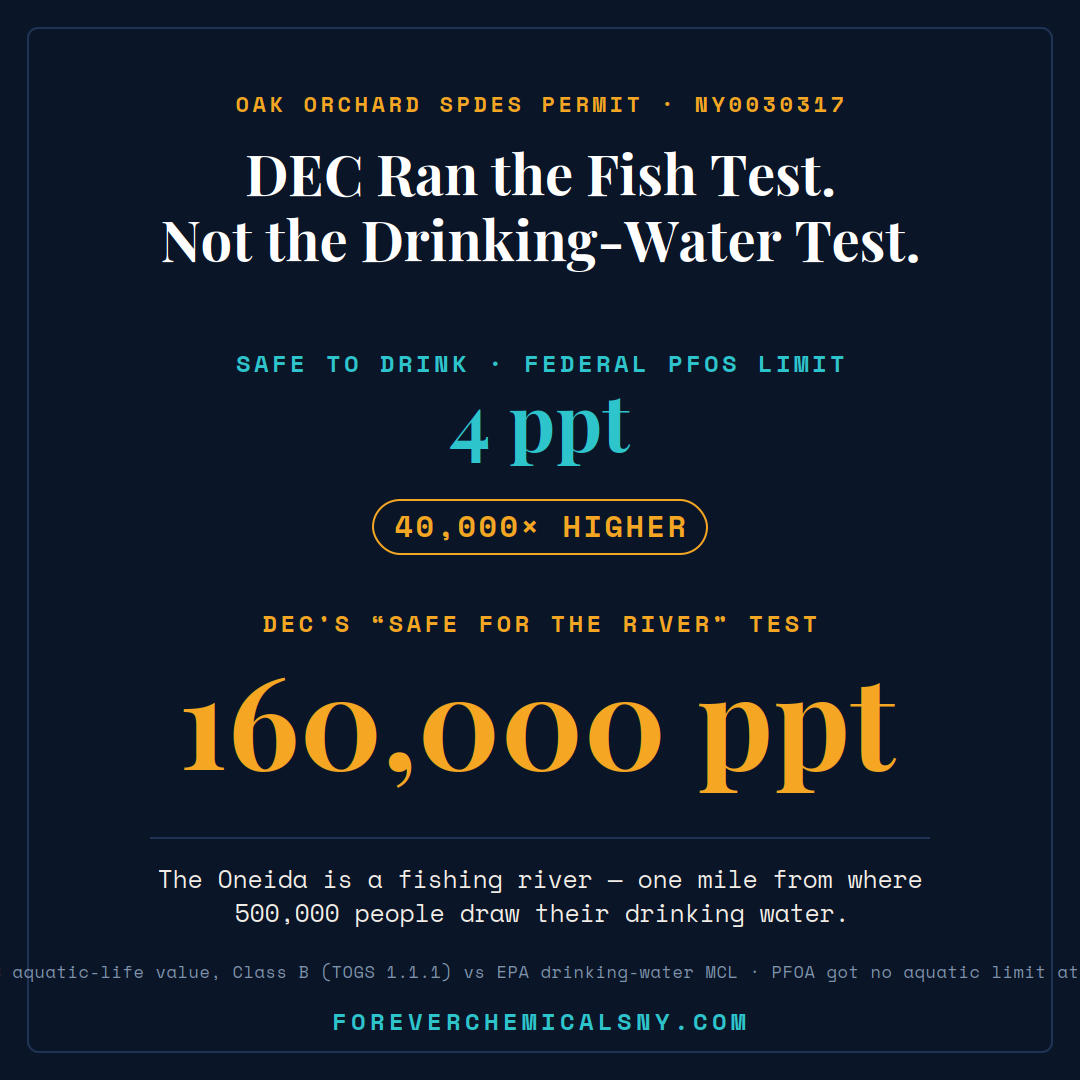
And dilution does not close that gap — it widens the illusion. The finding gives the discharge credit for the river’s flow, thinning the concentration before comparing it to that already-enormous number. But dilution destroys nothing and removes nothing. The same mass of forever chemical is still in the water, spread thinner, on its way to a drinking-water intake a mile past the river’s mouth — bioaccumulating in the fish along the way.
“Enforceable” — and then their own footnote
The letter opens by saying “both the permit limits and action levels are enforceable.” Then it prints the DEC’s own regulatory definition of an action level: a monitoring requirement that, when exceeded, triggers additional monitoring and department review “to determine if numerical effluent limitations should be imposed.”
Read those two lines together. What is enforceable is the duty to monitor and report. An action level does not cap how much PFAS can be discharged. By the DEC’s own definition, it is the trigger for deciding whether to write a real limit later. Our point from the start — action levels are not enforceable limits — is not refuted here. It is confirmed, in a footnote.
The limits that don’t exist yet
Watch where the letter sends the actual enforceable limits. The action levels, it says, “provide a basis for” the county sewer authority “to establish and implement enforceable local limits for industrial users under its pretreatment program.”
Read the verbs: provide a basis for, to establish. Future tense. Discretionary. Not done. The DEC’s answer to “where are the enforceable PFAS limits” is, in effect, the county can write some through its pretreatment program — eventually, if it chooses. Those limits do not exist today. The Region 7 Director just confirmed that in writing. Which is exactly why the sequence has to be limits first, then design, then contract — and why the moment to fix it is now, before the design-build contract for the industrial plant is awarded.
Why no TOP Assay was required
Everything in this letter rests on one load-bearing sentence: the discharge “does not demonstrate reasonable potential to exceed” the guidance values. That is the finding that lets the DEC skip enforceable limits. It is also the finding that lets the DEC skip stronger monitoring. So it is worth asking what that analysis could actually see.
A reasonable-potential analysis is only as good as the chemicals it measures. The permit’s monitoring runs on EPA Method 1633, which targets 40 PFAS compounds — largely the long-chain ones the industry phased out years ago. Semiconductor wastewater carries something else: short-chain replacements and fluorinated precursors that Method 1633 does not capture. A Cornell study identified 133 PFAS compounds in fab wastewater. Most of them are invisible to the test the permit relies on.
The Total Oxidizable Precursor (TOP) Assay exists precisely to solve this. It oxidizes those hidden precursors into forms the instruments can finally measure — it turns the invisible fraction visible. This campaign’s Demand #3 is that the permit require the TOP Assay alongside Method 1633.
During the public comment period, this was not a fringe request. Nine commenters formally asked the DEC to require PFAS monitoring beyond Method 1633 — the Onondaga Nation, the Sierra Club’s New York chapter, Clean Water Action, CHIPS Communities United, the Center for Public Environmental Oversight, Jobs to Move America, a PhD chemist, a licensed professional engineer, and others. The DEC’s answer, in its own Responsiveness Summary, to those requests was the same sentence: “No changes have been made to the permit in response to this comment.”
Measure only the fraction the old method can see. Run the reasonable-potential analysis on that fraction. Find “no reasonable potential.” Cite that finding to justify not measuring the rest. The conclusion is written into the method.
There is one more problem the letter does not mention. The industrial section of the Oak Orchard plant — the part being built to treat Micron’s discharge — has not been designed or built. A reasonable-potential analysis for that outfall could not have rested on measured effluent from an operating plant, because no such plant exists yet. It rests on projections and assumptions. The DEC has not made those inputs public. We have filed to see them.
What we’re asking now
The DEC answered the question we asked. Its answer raises a sharper one, and we are putting it back on the record: what human-health-based value did the DEC use to assess PFOA and PFOS for the people who drink from Lake Ontario — given that the mercury standard it cites is a human-health standard, and the PFAS values it cites are not?
Alongside that, we are requesting the reasonable-potential analysis worksheets for both mercury and PFAS on this permit: the effluent concentrations assumed, the dilution credited, and the specific guidance values applied. That single document will show exactly which numbers the “no reasonable potential” finding was built on — and whether the assumed PFAS load is anywhere near what a semiconductor fab actually discharges.
Limits first. Design second. Contract third. There is still time to do this in the right order — but only until the contract is signed.
Sources
NYSDEC Region 7, Response to Citizen Inquiry — Dereth Glance, Director, July 3, 2026. Quoted verbatim above; full PDF on file.
SPDES Permit NY0030317 (Oak Orchard Wastewater Treatment Plant), signed April 10, 2026.
6 NYCRR 703.5 (mercury water quality standard); TOGS 1.1.1 (PFOA/PFOS aquatic-life guidance values); 6 NYCRR 750-1.2(a)(2) (definition of “Action Level”); TOGS 1.3.14.
DEC Responsiveness Summary (April 10, 2026) — denial language quoted verbatim.
Jacob et al., Environmental Science & Technology (2021) — 133 PFAS compounds identified in semiconductor fab wastewater.
Lake Ontario PFAS baseline — approximately 11 ng/L total, IADN monitoring, 2021–2023.
Every factual claim on this page traces to a primary public record.