What Has Happened. What Comes Next.
This section updates weekly. We are documenting every step of this campaign in real time — the meetings, the responses, the silences, and the wins. Transparency is both a value and a strategy.
2026
Thirty-Six Days of Silence
On July 21 we handed the Environmental Protection Committee two draft resolutions — printed in full in the evidence packet every member received that night. One asks DEC to reopen the Oak Orchard permit and set enforceable, numeric PFAS limits at Micron’s own outfall, verified by EPA Method 1633A plus the TOP Assay. The other asks the County to write those limits — and full Micron liability — into Micron’s industrial user agreement, before the construction bond is authorized and before the Kiewit contract is executed. More than 2,300 petition signatures went in with the same materials.
Thirty-six days later, we have had no response to either one. Not to the resolutions. Not to the petitions. The design-build contract still has not been executed and the design is still unfinished, which means everything we asked for on July 21 can still be done today. Every day of silence is a day of that window closing.
2026
The PFAS the Test Can't See
Lenny Siegel of the Center for Public Environmental Oversight pointed us to the compound that makes up most of the PFAS in semiconductor wastewater — TFA, an "ultrashort" forever chemical that EPA Method 1633 doesn't even measure. Two peer-reviewed, industry-funded studies confirm it: TFA is the biggest PFAS by mass in fab wastewater, and filtration barely removes it — and never destroys it.
2026
Micron's Own Numbers: Four Years of PFAS, Released Under Records Law
Public records from Virginia just handed us the strongest evidence yet — and it's Micron's own lab data. At the company's existing fab in Manassas, VA, Micron samples the wastewater it sends to the local treatment plant every quarter and reports the results. Across four years: 270–2,300 ng/L of total PFAS, with PFOA running 8–20× the federal drinking-water limit every single quarter. This is what "treatable wastewater" actually looks like before it reaches a plant like Oak Orchard — and it's only counting 40 of the hundreds of PFAS in fab wastewater.
2026
Five Minutes, and a Standing Ovation
We were told the Environmental Protection Committee would hear a full presentation, with Micron and the DEC in the room to answer for the permit. They backed out — and it became a five-minute public forum. So our PFAS team laid out the science and the liability, and I closed by introducing my two daughters. Kristina walked the committee through the permit; Riley — sixteen years old — made the case for enforceable limits, and the room rose in a standing ovation.
2026
Three Documents, One Contradiction — DEC Said Yes, the County Said the Same, Then DEC Admitted the Opposite.
The claim that this permit protects you has been repeated by the people responsible for it — three times, three ways. Set them side by side, every word from an official source.
One. On video, at the County Environmental Protection Committee, NYSDEC Region 7 Director Dereth Glance was asked point-blank whether the permit for Micron’s discharge has enforceable PFAS limits. She said yes. Two. In writing, Onondaga County’s own response to residents calls the PFOA and PFOS action levels “an enforceable level that requires the permitees to investigate and mitigate” anything over the trigger. Three. In writing, on July 3, 2026, DEC admitted the opposite: the Department is “not required to establish enforceable effluent limitations for PFOA or PFOS in this permit.”
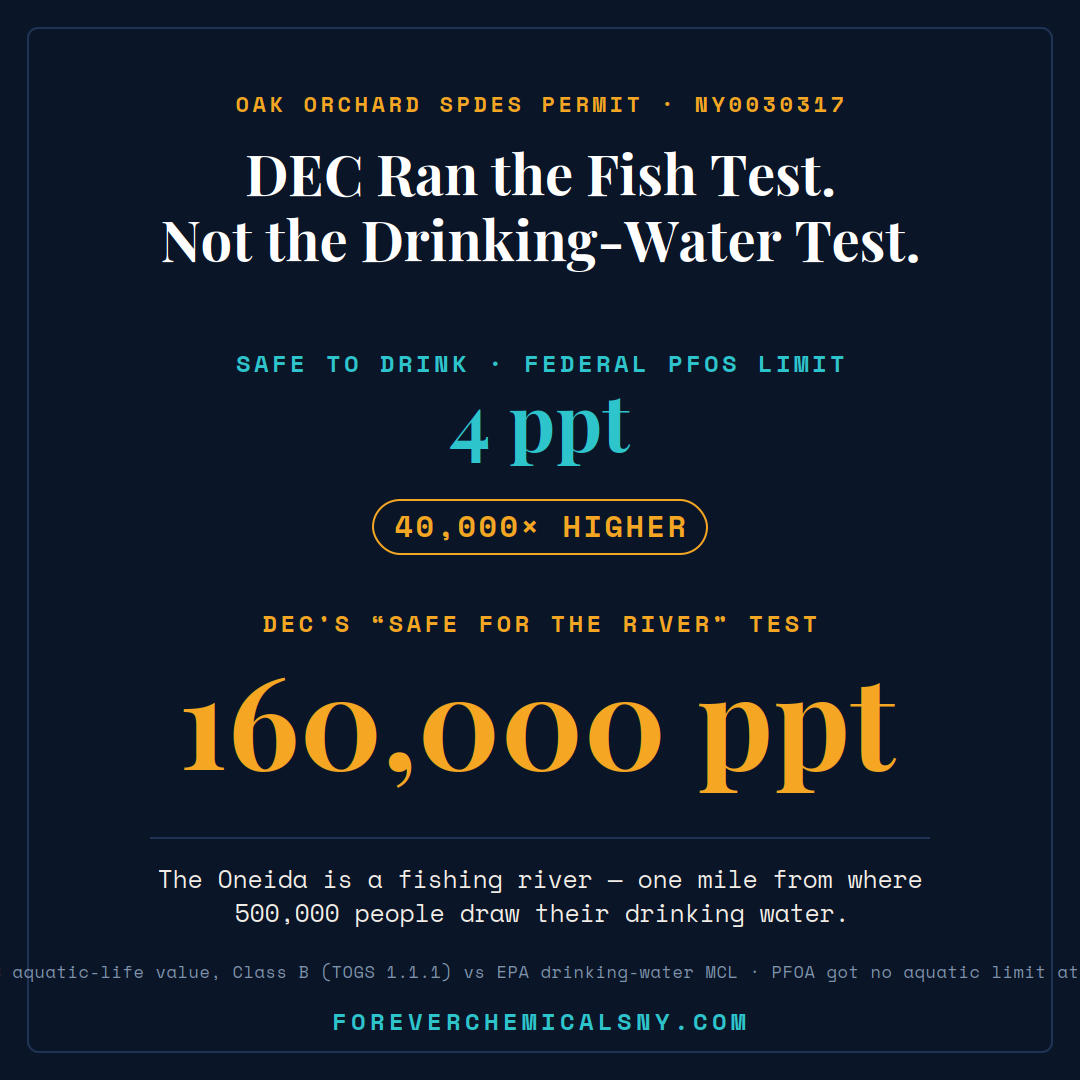
Here is the word game. Yes, an action level is “enforceable” — but what is actually enforceable is the paperwork: investigate, mitigate, report. Nothing caps how much PFAS Micron can send into the river. We proved the gap with one question: mercury, on that same outfall, carries a hard enforceable number of 1.40 ng/L; PFAS got only an action level. DEC’s explanation, in the July 3 letter, is that mercury was measured against a standard that protects human health while PFAS was measured against one that protects fish. The human-health test for the 500,000 people drinking from Lake Ontario downstream was never run.
The same County response also reassures residents the permit monitors “the remaining 38” PFAS compounds — two plus thirty-eight makes forty, quietly offered up as the whole of PFAS. It isn’t. Forty is the exact target list of EPA Method 1633; Cornell identified 133 PFAS compounds in semiconductor fab wastewater, and the short-chain and precursor compounds a modern fab actually discharges are the ones that method misses. “Remaining” does the same work “enforceable” does — it makes a fraction sound like the whole.
We have posted all three, quote by quote, with the full response. Read the record, document by document →
2026
A County Corporation Most People Have Never Heard Of Just Voted to Move the Billion-Dollar Micron Plant Forward — Behind Closed Doors.
On June 16, 2026, the board of the Onondaga County Water Redevelopment Corporation (OCWRC) voted to open negotiations with Kiewit Infrastructure as design-build contractor for the Oak Orchard industrial wastewater treatment plant being built for Micron’s discharge. According to Syracuse.com, the board met for roughly 80 minutes in closed session and spent under four minutes in open session; the published agenda did not flag that a contractor vote was coming, and the meeting was noticed the day before. The contract is not yet signed — the county says it expects to finalize terms over the summer.
We want to be precise, because precision is the whole point of this campaign. The corporation itself is legal. Counties are permitted to form local development corporations, and Syracuse.com has reported as much. What we are raising is narrower and documented in the corporation’s own founding papers. The certificate of incorporation (filed April 3, 2024) names the County Executive as the corporation’s sole member, with authority to appoint all seven directors, who serve at his pleasure. It authorizes the corporation to borrow “without limit as to amount” and to issue bonds without a vote of the County Legislature. And the corporation’s own bylaws — consistent with Public Authorities Law § 2825 — call for a board with a majority of independent directors. Five of the seven current directors are senior County staff who report to the County Executive: the County Attorney (acting chair), the CFO, a Deputy County Executive, the Chief of Staff, and the Wastewater Commissioner.
Why this matters for the permit fight: when the Legislature voted 15–2 to create the industrial sewer district in March, members said they were doing it to “keep a seat at the table” and preserve oversight as the project developed. A financing vehicle that can borrow and bond without a Legislature vote is, by design, a seat farther from that table. The design-build contract is the last point at which enforceable PFAS limits can be written in at low cost. That decision should be made in public, by the body the voters elected — not finalized inside a corporation whose board answers to one office.
Our position is unchanged: limits first, design second, contract third. Before this contract is signed, the Industrial Wastewater Discharge Permit the County will write for Micron should contain enforceable, numeric PFAS limits using EPA Method 1633A plus the TOP Assay. We have requested an advisory opinion from the New York State Committee on Open Government regarding the June 16 meeting, and the public record will be posted here as it develops.
2026
The PFAS Discharge Disclosure Act Clears the Legislature — and Heads to the Governor’s Desk.
On June 1, 2026, the New York State Assembly passed the PFAS Discharge Disclosure Act (A.5832-B, sponsored by Assemblymember Anna Kelles; Senate companion S.4574-B, sponsored by Senator Rachel May). The State Senate had already passed it 62–0 on February 10. With both houses now in agreement, the bill returns to the Senate for transmittal to Governor Kathy Hochul — the last step before it reaches her desk for signature.
On the morning of the vote, ForeverChemicals NY founder Todd Fitzsimmons exchanged emails directly with Assembly Speaker Carl Heastie, urging him to bring the bill to the floor before the session window closed. Later that day, the Speaker put it to a vote, and it passed. After three prior sessions in which this bill cleared the Senate only to die in the Assembly, it is finally through both houses.
This matters here. The bill requires any “covered industrial user” seeking to send industrial wastewater to a public treatment plant — a POTW like the Oak Orchard plant being built for Micron’s discharge — to test for PFAS and submit the results to both the plant and the DEC before the discharge begins. New POTW permit applicants must submit projected PFAS monitoring as part of their application, and the DEC must publish the results where the public can see them. The discharge can no longer move through the public system in the dark.
We want to be precise about what this is and is not, because precision is the whole point of this campaign. This is a monitoring and disclosure law — it turns the lights on. It is not an enforceable discharge limit. It does not cap what Micron can send into the Oneida River, and it does not change our core demand: enforceable PFAS limits written into the permit before Onondaga County awards the design-build contract. The bill also names EPA Method 1633 and leaves the Total Oxidizable Precursor (TOP) Assay to the DEC’s discretion rather than requiring it — the exact gap our Demand #3 addresses. The law validates the direction; it does not finish the work.
Now we ask the Governor to sign it.
2026
Defund the DEC.
ForeverChemicals NY founder Todd Fitzsimmons today published “Defund the DEC” — a personal essay drawing on forty years of working with the New York State Department of Environmental Conservation to explain why the agency is the structural reason Micron’s PFAS discharge into the Lake Ontario watershed is moving forward without enforceable limits.
The essay is built around three documented patterns from those forty years. First, the dual-wall tank law: when the DEC discovered 25% of New York’s underground fuel tanks were leaking, it passed a law requiring dual-wall tanks. Fitzsimmons FOILed the spill database — three printed volumes — and demonstrated that 90% of the leaks were in the piping, not the tanks. The DEC agreed with the analysis. The law was never amended. Second, the case of a DEC field employee steering emergency cleanup work to a competitor whose crews were building the employee’s Adirondack hunting camp for free; when reported, the DEC promoted him to Albany to oversee Major Oil Storage Facilities, where he then steered tank-farm operators toward a flammable liner product made by a major defense contractor. Third, the late-1990s EPA finding that over 67% of New York’s underground fuel facilities were out of compliance — one of the worst rates in the country — with the DEC failing to enforce while honest operators were sold out of the market by operators who ignored the law.
The essay then turns to the Micron permit and documents the same pattern at infinitely higher stakes: although the DEC’s own framework names semiconductor manufacturing a PFAS priority industry, Micron’s discharge is routed through a county-owned municipal treatment plant — placing it outside the industrial framework that would have required enforceable limits and under the DEC’s weaker rules for public sewage works; and during the public comment period on permit NY0030317, the DEC denied every single request — from at least twenty engineers, chemists, and PhDs — that the Total Oxidizable Precursor Assay be required. The TOP Assay is the only validated method that detects the “dark PFAS” compounds Cornell scientists identified in semiconductor wastewater — the same compounds EPA Method 1633A, the only test the DEC requires, does not detect. Cornell’s peer-reviewed analysis found 133 PFAS compounds in fab wastewater; Method 1633A captures less than 6% of them.
The federal backstop is gone — the EPA’s proposed PFAS industrial discharge rule was withdrawn on day one of the Trump administration. The Boise precedent is fully realized: the Boise River is contaminated, the City of Boise has bonded over half a billion dollars for cleanup after Micron walked away from the joint treatment plan, and 4,225 acres of city-owned farmland at Twenty Mile South Farm have received biosolids from the treatment plants that handle Micron’s discharge — fertilizing alfalfa, corn, and wheat sold on commodity markets.
The essay’s thesis: politicians are permitting this because they have an excuse — “the DEC is on it.” County Executive Ryan McMahon used that exact phrase in response to direct outreach about Micron’s PFAS discharge. The essay argues that the only way to remove the excuse is to remove the agency that provides it.
2026
TI Life Publishes Essay; Clarkson Breakthrough Validates Demand #4.
Thousand Islands Life Magazine today published “An Essay: What’s Coming Down the River?” by ForeverChemicals NY founder Todd Fitzsimmons. The essay frames the case for a downstream audience — people who live, fish, and hold property along the St. Lawrence River between Cape Vincent and Massena, and on the Canadian shore.
In an editor’s note, TI Life editor Susan Smith confirmed she forwarded the essay to Save the River and the Thousand Islands Land Trust — both organizations already tracking the issue — and to the Ontario Ministry of the Environment, Conservation and Parks. This is the first time the campaign’s documentation has entered the binational regulatory system through an editorial channel.
Smith also flagged a parallel development. On May 1, 2026, researchers at Clarkson University in Potsdam — in the same watershed where Micron’s discharge will eventually arrive — published a breakthrough PFAS destruction method in Nature Communications (Guan, Xu, Jain et al.; Yang and Muhich corresponding authors; DOI 10.1038/s41467-026-71263-9). Associate Professor Yang Yang’s team developed a Pd-TiO2 cathode that uses cathodic adsorption and a hot-electron mechanism to destroy PFAS under mild conditions, without the harmful byproducts that have plagued previous destruction approaches. The work is a Clarkson–Arizona State–Yale collaboration.
This matters for Demand #4 (Require PFAS Destruction Technology — not filtration). Yang’s group has now published three peer-reviewed destruction methods in roughly eighteen months: piezoelectric ball milling on spent ion-exchange resins (April 2025), additive-free ball milling on granular activated carbon (November 2025), and now this photo-electrochemical method. The standard regulatory deflection — “destruction technology isn’t ready” — is no longer credible. The technology is being developed in New York’s North Country, downstream in the same St. Lawrence system that Micron’s discharge will reach.
The campaign is reaching out to Dr. Yang’s group this week.
2026
Onondaga County Refuses Public Access to List of Firms Bidding on $550M Micron Treatment Plant. ForeverChemicals NY Files Administrative Appeal.
On March 20, 2026, ForeverChemicals NY filed a Freedom of Information Law request with the Onondaga County Division of Purchase asking for one thing: the names of firms that submitted Statements of Qualifications for the $550 million Oak Orchard Industrial Treatment Plant design-build contract, plus any shortlist resulting from the County’s review. The request expressly excluded all proprietary technical and pricing information. It asked only for the names.
On May 6, 2026, the Onondaga County FOIL Office denied the request in full, invoking Public Officers Law § 87(2)(c) (records that “if disclosed would impair present or imminent contract awards”) and § 87(2)(d) (records that would “cause substantial injury to the competitive position of the subject enterprise”). The County’s position, in plain language: taxpayers are not entitled to know which firms are competing for a $550 million publicly-funded wastewater treatment plant that will treat semiconductor wastewater discharged into a drinking water source for half a million Central New Yorkers.
On May 9, 2026 at 12:49 a.m., ForeverChemicals NY filed a six-section administrative appeal to the Onondaga County FOIL Appeals Officer under Public Officers Law § 89(4)(a). The appeal demonstrates that neither cited exemption supports the County’s categorical denial: § 87(2)(c) requires an “imminent” contract award and the County’s own position that the contract has “not yet been fully executed” is the converse of that standard; § 87(2)(d) protects the bidder’s commercially sensitive content, not the bare fact that a firm has submitted a qualifications statement on a publicly-advertised RFQ; and § 89(3) requires partial disclosure where full denial is unwarranted. The Appeals Officer is required by statute to issue a written determination within ten business days — on or about May 23, 2026.
The complete record — original request, denial letter, and administrative appeal — is now posted as Documents 12, 13, and 14 in the Document Library.
2026
Three County Legislators. An Hour of Conversation. An Invitation to Present on July 21.
At a Greening USA event this week, ForeverChemicals NY met three members of the new Onondaga County Legislature majority: Environmental Protection Committee Chair Gregg Eriksen (D, District 6), Majority Leader Nodesia Hernandez (D, District 17), and Elaine Denton (D, District 10), the freshman legislator from Manlius who grew up on her family’s Central New York dairy farm and ran on transparency and environmental protection. The conversation with Chair Eriksen continued for roughly an hour after the event closed. He shared his personal contact information and invited the campaign to present to the Environmental Protection Committee at its July 21, 2026 meeting — a date that falls inside the bond authorization window for the Industrial Treatment Plant.
Three of the ten Democratic legislators in the new 10–7 majority have now heard the technical and fiduciary case directly: that the bond authorization is the last enforceable-limit leverage point remaining before the design-build contract is awarded; that the County, not Micron, holds the SPDES permit and therefore the downstream liability; and that the County has the authority to write enforceable PFAS limits into the Industrial Wastewater Discharge Permit it will itself issue to Micron. The campaign now has a date, a forum, and three legislators in the leadership chain who know the file.
Also on the record this week: the formal letter to Empire State Development President Hope Knight — first transmitted electronically on April 9 to ask ESD to define “sustainable wastewater management” in Micron’s Green CHIPS Sustainability Plan before the design-build contract is awarded — has now been transmitted by USPS Certified Mail, Return Receipt Requested to Commissioner Knight and six cc’d recipients: Governor Kathy Hochul, NYSDEC Commissioner Amanda Lefton, NYSERDA President Doreen Harris, NYSDEC Division of Water Director Carol Lamb-LaFay, Onondaga County Executive J. Ryan McMahon II, and Sierra Club CNY Conservation Chair Don Hughes. The signed letter is now in the Document Library.
A parallel FOIL request to Empire State Development has also been filed, requesting Micron’s submitted Green CHIPS Sustainability Plan in all draft and approved versions, the ESD-developed Sustainability Plan template and applicant guidance, all annual progress reports Micron has submitted under the Green CHIPS program, and ESD’s approval documentation — including any conditions, modifications, compliance reviews, or corrective actions issued to Micron to date. The full FOIL letter is also in the Document Library.
2026
Two Fabs. Eighty Tons. The Story in DEC’s Other Permit.
While the SPDES water permit was being signed and contested, DEC was also issuing the Title V air permit for Micron’s Clay campus. We have now read it. It runs 45 pages — and it documents air emissions the public conversation around this project has not yet engaged with. Permitted potential to emit, from the first two of four planned fabs alone: roughly 80 tons per year of fluorinated air pollutants, of which approximately 65 tons meet the OECD international working definition of PFAS. The single largest line item is 57 tons per year of tetrafluoromethane (CF4), a greenhouse gas with an atmospheric lifetime of roughly fifty thousand years. The second line item is 7.8 tons per year of perfluoro N-alkylmorpholine — a named PFAS in the 3M Fluorinert family.
The chemistry findings extend further. Many of the lighter fluorinated compounds in the permitted inventory will eventually break down in the atmosphere — and a common end product of that breakdown is trifluoroacetic acid (TFA), an ultra-short-chain PFAS now detected at rising concentrations in rainwater, surface water, and human serum worldwide. A meaningful fraction of these airborne emissions will not stay airborne. They will return to ground as a forever chemical of their own, distributed through Central New York’s precipitation, surface waters, and groundwater recharge. The permit itself references a perfluorinated compounds dispersion model on file at DEC. The model has not been made public. ForeverChemicals NY has filed a FOIL covering both the PFAS and the inorganic fluoride dispersion modeling.
There is also a separate climate finding embedded in the file: DEC’s own December 2025 Justification Statement that approving Micron’s permits is “inconsistent with the attainment of the statewide GHG emission levels under the Climate Act.” DEC issued the air permit anyway, citing national security and the federal CHIPS Act. It is the first time the Department has used its Commissioner’s Policy 49 to override a Climate Act inconsistency finding — the same legal finding it has used three times to deny Title V permits to other applicants. Full analysis, with page citations to the Permit Review Report and the Justification Statement, at the link below.
2026
The Number Is 1,136.
On page 164 of a 213-page engineering report prepared for Onondaga County by Brown and Caldwell, in a table titled “Projected Water Quality Based Effluent Limits for Discharge to the Oneida River,” the engineers list the projected effluent concentration for Perfluorooctane Sulfonic Acid (PFOS) at 1,136 µg/L. Converted to the units EPA uses for drinking water, that is 1,136,000 ng/L. The federal drinking water limit for PFOS, finalized in April 2024 and still in effect today, is 4.0 ng/L. The ratio is 284,000 to 1. Even after the engineers’ assumed 7.1× dilution in the river, the projected instream concentration is roughly 160,000 ng/L — 40,000 times the federal drinking water limit.
The report’s entire plan for treating PFAS appears on page 1-9. It begins: “Micron stated during the workshops that PFAS and mercury are anticipated in low concentrations...” The compounds, the report continues, “will be limited in the discharge from Micron to a level that can be removed in the biological treatment to values below the discharge requirements.” Biological treatment does not destroy PFAS. It never has. What it does is concentrate PFAS — some into the effluent, some into the sludge. The sludge from Oak Orchard is trucked to Metro Syracuse for drying, then landfilled — PFAS and all.
The document that contains all of this is stamped “CONFIDENTIAL — Exempt from FOIL per POL 87(2)(c)&(d)” on two of its pages. The County is asserting the document is legally shielded from public records requests. The County is also hosting the document on its own public web server, where it has been downloadable since November 2025. One of those two things is wrong. We are now hosting the full report in our Document Library.
2026
The Record: Seven Decisions. Every One Documented.
The first purpose of government is to protect its people. On this project, at every level — federal, state, county, city — government had a choice. At every decision point, government chose accommodation. At the one decision point that would have produced the science required to make accommodation unnecessary, the administration killed the program.
ForeverChemicals NY has published a new reference page documenting the seven government decisions that produced this permit. The EPA regulating compounds industry stopped using. Commerce Secretary Lutnick killing PRISM — the $35 million CHIPS Act program that would have generated the science to regulate what fabs actually discharge. Boise’s 2014 private canal contract with no PFAS disclosure. NYSDEC leaving semiconductors off the priority list. ESD’s $5.5 billion in state aid tied to a “sustainability” term that has never been defined. Hochul’s administration waiving New York’s climate law on national-security grounds. Onondaga County bonding $549 million for the municipal plant expansion (December 29, 2025, 12–5 vote) while a separate industrial plant bond — estimated by the County’s own engineer at $1.4–$2.6 billion — remains pending. Every one of those decisions is documented in the public record. Every one is sourced on the page.
2026
1,002 Signatures.
The petition crossed one thousand signatures today. The exact count is 1,002. The names came from 928 New Yorkers, 27 Ontario residents along the shared St. Lawrence River, and 47 signers from other states.
The geography of the New York signers tells the story of who is actually paying attention to this. Syracuse leads with 108. The Thousand Islands corridor — Clayton (59), Alexandria Bay (42), Wellesley Island (24), Cape Vincent (18), Hammond (13) — combined for 156 signers from communities sitting directly on the discharge pathway, two and a half hours downstream of the outfall. Liverpool (35), Clay (29), Cicero (27), Brewerton (16), Baldwinsville (17), and Phoenix (8) cluster around the outfall itself. Rochester contributed 27. Watertown 20. Oswego 11.
The 27 Ontario signers matter for what they represent: the recognition, on the Canadian side of the watershed, that this is not a Central New York issue. The St. Lawrence River does not stop at the international border. Neither does PFAS.
882 of the 1,002 signers (88%) opted to have their names publicly displayed. 287 (29%) opted in to receive campaign updates. Both numbers will translate into pressure on the agencies that have, so far, treated this permit as a closed question.
To everyone who signed: thank you. The window to fix this permit before the design-build contract is awarded is still open. The next thousand will matter as much as the first.
2026
The Plant Is Not a Solution. It Is a Diffuser.
Micron’s wastewater treatment plant has been sold to the public as a solution to the PFAS problem. It is not a solution. It is a diffuser.
The plant is an aerobic membrane bioreactor. Biology does not degrade PFAS — the carbon-fluorine bond is the strongest bond in organic chemistry, and no microbe is known to break it under standard wastewater treatment conditions. The permit’s entire case for no-significant-impact rests on a statement in the Conceptual Design Engineering Report that Micron’s PFAS will be “removed in the biological treatment.” That claim is chemically false. What the bioreactor actually does to PFAS is split it into three outputs.
WATER. Method 1633 measures 40 PFAS compounds — the long-chain ones the industry phased out a decade ago. Short-chain PFAS (what modern fabs actually use) pass through biological treatment with low or negative removal. Peer-reviewed studies of real MBR systems have documented negative removal of short-chain PFAS — the biological step transforms fluorotelomer precursors into the stable perfluoroalkyl acids that Method 1633 targets, increasing downstream concentrations of the regulated compounds. The permit has no enforceable limits on 38 of those 40 compounds.
AIR. Aerated tanks eject PFAS-enriched aerosols continuously. PFAS molecules are surface-active: they concentrate at the air-water interface of every bubble. When bubbles burst at the surface of an aerated tank, they eject a PFAS-enriched droplet into the headspace above the water. This is not speculation. It is the same physical principle commercial foam-fractionation PFAS-removal systems use deliberately. An MBR does it continuously, with nothing capturing it. The Oak Orchard plant has no air permit — only a minor-source Air Facility Registration. The SEQR Findings Statement concluded “the facility has not identified any high toxicity air contaminants that are to be emitted from the IWWTP.” HTAC is a regulatory list under 6 NYCRR Part 212. There is no HTAC entry for PFOA, no entry for PFOS, and no entry for any of the 38 short-chain PFAS the plant will aerosolize every day. The compounds aren’t on the list, so they can’t be on the emission inventory. No EPA-approved method exists to measure PFAS in stack gas or ambient air at compliance scale. You cannot enforce an air limit on a compound you cannot measure.
SOIL. Whatever PFAS the biological step does capture concentrates in the sludge. Oak Orchard sludge goes to Metro Syracuse, where a $23 million dryer cuts its weight to lower the landfill tipping fees, then to a landfill such as Seneca Meadows — PFAS-concentrated. Landfilling does not destroy PFAS: it migrates into leachate that is collected and typically sent back to a wastewater plant that cannot remove it, and can reach groundwater. The permit requires no PFAS testing of the biosolids before disposal. Maine and Connecticut have banned land application of PFAS biosolids outright; New York sets no limits on where this sludge can go.
Water. Air. Soil. Three pathways. Zero enforceable limits on the compounds most at issue on any of them. The permit treats the plant as a black box that makes PFAS disappear. It is not a black box. It is an exhaust.
2026
DEC Issued the Permit on April 10. The Documents Speak for Themselves.
On April 10, 2026, the New York State Department of Environmental Conservation issued the modified SPDES permit for the Oak Orchard Wastewater Treatment Plant — NY0030317, effective May 1, 2026, expiring April 30, 2031. The agency released the permit together with a 200-page Responsiveness Summary addressing public comments, a 14-page SEQR Findings Statement, and a 5-page Justification Statement finding the project inconsistent with New York’s own climate law. The permit has no enforceable discharge limits on 38 of the 40 PFAS compounds it covers. The two compounds that do have limits are the ones the semiconductor industry stopped using over a decade ago. And the existing Oak Orchard plant — before Micron sends a single drop of wastewater — already exceeds the permit’s own action level for PFOS.
We have read all four documents. We have posted a detailed analysis, with page citations to the signed permit and its companion filings, at the link below.
2026
“Not Cost-Effective” — Cost-Effective for Whom?
When NYSDEC Division of Water Director Carol Lamb-LaFay stated that PFAS treatment upgrades at public plants are “often not cost-effective,” she was using the term the way regulators always use it: capital cost of the treatment system plus annual operating cost, weighed against the incremental reduction in pollutant load. That is the entire analysis. That is what the permit decision is based on.
Here is what that analysis does not include:
Medical costs. PFAS exposure is linked to kidney cancer, testicular cancer, thyroid disease, ulcerative colitis, high cholesterol, immune system disruption, and developmental harm in children. The lifetime treatment cost for a single PFAS-linked cancer case can exceed $500,000. That discharge flows down the Oneida and Oswego rivers into Lake Ontario, the drinking water source for 500,000 Central New Yorkers. The cost-effectiveness analysis contains no line item for any of this.
Lost tourism and recreation. Micron’s discharge enters the Oneida River, flows to the Oswego River, into Lake Ontario, and directly into the St. Lawrence River — the heart of the Thousand Islands. The Thousand Islands region (Jefferson, Oswego, and St. Lawrence counties) generated $725 million in visitor spending in 2023, supporting 8,768 jobs, according to the New York State tourism impact report published by Empire State Development. Jefferson County alone — home to the Thousand Islands Bridge, Alexandria Bay, Clayton, and Boldt Castle — recorded $348 million in visitor spending in 2024, with tourism accounting for 11% of the county workforce. That economy runs entirely on clean water and the perception of clean water. A PFAS contamination finding in Lake Ontario, a fish consumption advisory on the St. Lawrence, or a single headline connecting the Oneida River discharge to Thousand Islands water quality would not be a line item in a permit decision. It would be an economic catastrophe that no tourism marketing budget could fix. The cost-effectiveness analysis contains no line item for any of this.
Property values. PFAS contamination findings have devastated property values in affected communities across the country. Homes near contaminated water sources in Michigan, Vermont, and New Hampshire have lost tens of thousands of dollars in value. The cost-effectiveness analysis contains no line item for any of this.
Remediation. The history of environmental contamination is uniform on one point: prevention costs a fraction of cleanup. The Onondaga Lake remediation — not yet complete — has cost over $1 billion for a lake one-tenth the size of the Oneida River watershed. The cost-effectiveness analysis contains no line item for any of this.
Funerals. We will not assign a dollar figure to this one. But the families in Hoosick Falls, Petersburgh, and Newburgh who spent years drinking PFAS-contaminated water before anyone told them probably have a view on what “cost-effective” means.
We are not asking DEC to do something technically impossible. We are asking DEC to require an industrial discharger to remove its own waste before it enters a public drinking water watershed — which is exactly what DEC’s own December 2025 guidance says should happen. The question of whether that is “cost-effective” depends entirely on whose costs you are counting.
2026
DEC’s Own Director Said Public Treatment Plants Can’t Handle PFAS. So Why Is Onondaga County Being Asked to Bond $550 Million for One?
On January 12, 2026, the Adirondack Explorer published a statement from Carol Lamb-LaFay, P.E., Director of the NYSDEC Division of Water, that PFAS treatment upgrades at public wastewater treatment plants are “often not cost-effective and in many cases technically impracticable.”
Read that again in the context of this project: the Director of the Division of Water that issued SPDES permit NY0030317 — a permit with zero enforceable PFAS discharge limits — has publicly stated that public plants cannot cost-effectively or technically handle PFAS. Onondaga County is being asked to bond over half a billion dollars to build one of those plants. Ratepayers, not Micron, are on the hook if the system fails to perform.
The statement appeared in the same month DEC finalized TOGS 1.3.14, its own guidance document, which states explicitly that “industrial dischargers of PFAS-laden waste should be required to remove the PFAS, since few public treatment plants have the technology to do so.” DEC’s December 2025 guidance and its Director’s January 2026 public statement say the same thing: industrial source removal is the answer. Micron is an industrial discharger. The permit requires nothing of the kind.
These are not our words. These are DEC’s. The permit was issued anyway, without industrial PFAS removal requirements, without enforceable discharge limits, and without requiring Micron to characterize its waste stream before the treatment plant is designed. The design-build contract has not been awarded. There is still time to correct this — but only if DEC applies the guidance its own Director signed and the standard she publicly described.
2026
Regional Lab Declines PFAS Testing — Cites Micron
We sent two RFQs to Atlantic Testing Laboratories (ATL) requesting quotes for PFAS water analysis using EPA Method 1633A and the Total Oxidizable Precursor (TOP) Assay. No response to either. After escalating to ATL’s regional manager, we received a reply from a project manager stating the lab would not perform any testing related to Micron.
We followed up clarifying that the samples in question were from the Boise River in Idaho — collected to assess whether PFAS levels near Micron’s existing fab there could affect local fishing. No reply.
We are not drawing conclusions about why a certified laboratory would decline scientifically routine water testing once the word “Micron” entered the conversation. We are simply noting that it happened — and that independent analytical capacity matters enormously when the agencies overseeing a $100 billion project have produced a discharge permit with zero enforceable PFAS limits. The search for a qualified, independent laboratory continues.
2026
Formal Letter to DEC Division of Water Director: The SPDES Permit Conflicts With DEC’s Own Guidance
ForeverChemicals NY submitted a formal letter to Carol Lamb-LaFay, P.E., Director of the NYSDEC Division of Water, documenting three specific conflicts between SPDES permit NY0030317 and the Division’s own regulatory framework — conflicts that exist on the record, in documents she signed.
Conflict 1 — The Priority Framework Does Not Reach Micron. TOGS 1.3.13 defines “priority facilities” for PFAS permitting by SIC code, and the DEC’s current priority list — updated August 2024 — includes semiconductor manufacturing, SIC 3674. But that industrial framework reaches only facilities that hold their own discharge permit. Micron does not: its wastewater is routed through the county-owned Oak Orchard plant, placing it under the DEC’s far weaker rules for public treatment works. The data shows why that gap matters — peer-reviewed research identifies 133 PFAS compounds in fab wastewater, and SIA’s own 2025 survey finds an average of 840 ng/L of PFAS in fab effluent, 210 times the federal drinking water limit. Micron’s Clay campus is projected to discharge 30.8 million gallons per day.
Conflict 2 — TOGS 1.3.14 Requires Action That Has Not Been Taken. DEC finalized TOGS 1.3.14 (“POTW Permitting Strategy”) in December 2025. It requires track-down programs and compliance schedules in SPDES permits to identify significant upstream PFAS sources. Micron is a significant upstream industrial source at Oak Orchard. No track-down program has been initiated. No compliance schedule exists in NY0030317.
Conflict 3 — DEC’s Own December 2025 Statement. Director Lamb-LaFay was quoted in January 2026 stating PFAS treatment upgrades at public plants are often “not cost-effective and in many cases technically impracticable.” DEC’s own December 2025 guidance states that “industrial dischargers of PFAS-laden waste should be required to remove the PFAS, since few public treatment plants have the technology to do so.” Micron is an industrial discharger. Oak Orchard is a public plant. The permit contains no industrial source removal requirement.
The letter requested initiation of a TOGS 1.3.14 track-down program; full PFAS characterization by Micron including non-targeted analysis; and reopening of the public comment period on NY0030317. It was copied to DEC Commissioner Amanda Lefton, Onondaga County Executive Ryan McMahon, and DEC Region 7 Permit Administrator Kevin Balduzzi.
2026
Formal Letter to Empire State Development: Define “Sustainable Wastewater Management” Before the Design-Build Contract Is Awarded
ForeverChemicals NY submitted a formal letter to Hope Knight, President, CEO, and Commissioner of Empire State Development, identifying a critical gap in Micron’s Green CHIPS Sustainability Plan. As a condition of receiving Green CHIPS tax credits, Micron signed a commitment to “sustainable wastewater management.” That phrase has never been defined. ESD has not yet approved the Sustainability Plan. The design-build contract for the Oak Orchard industrial treatment facility has not been awarded. That combination of facts is the campaign’s leverage point — and ESD holds it.
The letter argues that for a semiconductor fab discharging into a public drinking water watershed, “sustainable wastewater management” cannot mean a system designed without knowing what it must treat, treatment technology selected before the waste stream is characterized, or zero enforceable limits on the most bioaccumulative industrial chemicals the facility uses. Micron’s own consultant told DEC in November 2025 that establishing PFAS discharge limits was “not identified as a critical path issue.” DEC’s own December 2025 guidance states that industrial PFAS dischargers should be required to remove PFAS at source, because few public treatment plants have the technology to do so. The permit — as drafted and now signed April 10 — is inconsistent with that guidance on its face.
The letter requests that ESD, before approving the Sustainability Plan, require that “sustainable wastewater management” be defined to include: (1) full PFAS chemical disclosure to Onondaga County and DEC without NDA restrictions; (2) non-targeted PFAS characterization of Micron’s wastewater — including methods beyond EPA Method 1633A that can identify the “dark PFAS” compounds documented in fab effluent — completed before the design-build contract is awarded; (3) PFAS destruction technology, not filtration or concentration, as the required treatment endpoint; (4) annual public reporting of PFAS discharge concentrations; and (5) a commitment that Micron will not seek NDA restrictions with chemical vendors that prevent engineers from knowing what they are designing for.
The letter closes: “A Sustainability Plan that commits to renewable energy, LEED Gold, and permeable pavement — while leaving the treatment of the facility’s most persistent, bioaccumulative, and toxic waste stream undefined — is not a sustainability plan. It is a gap. The window to close it is still open. The leverage is yours.” Full source documentation for all factual claims is publicly available at foreverchemicalsny.com.
2026
New Page: The Incineration Myth — PICs, Hydrogen Fluoride, and Why 600°F Doesn’t Destroy PFAS
ForeverChemicals NY has published a technical briefing on products of incomplete combustion (PICs) from PFAS thermal treatment. At 600°F, PFAS is not destroyed — it is volatilized into an exhaust stream containing hydrogen fluoride, carbonyl fluoride (more acutely toxic than phosgene), newly formed PFAS compounds with unknown toxicity, and potent greenhouse gases. The 2022 National Defense Authorization Act imposed a federal moratorium on PFAS incineration after Congress found no proof existing incinerators could avoid generating harmful PICs. Published in solidarity with Fort Edward residents fighting the Clean Earth burn permit. Read the technical briefing →
2026
Solidarity with Fort Edward — ForeverChemicals NY Expands Statewide
ForeverChemicals NY posted in solidarity with Fort Edward residents fighting a proposed burn permit for PFAS-contaminated soil from out-of-state Air Force bases. The campaign is formally expanding from a Central New York focus to a statewide platform — different watersheds, same DEC, same permit culture, same pattern of moving the problem instead of solving it. Emergency rally Tuesday April 14, 5 PM, Fort Edward Fire Department. Fort Edward community group →
2026
Letters Filed with Governor Hochul and DEC Commissioner — 907 Signatures
Formal letters have been transmitted to Governor Kathy Hochul's Executive Chamber and to DEC Commissioner demanding that enforceable PFAS discharge limits — including full Method 1633A testing and the Total Oxidizable Precursor (TOP) Assay — be incorporated into the Oak Orchard SPDES permit before the industrial treatment plant design-build contract is awarded. The ask is narrow and technically grounded: require the right tests before the permit is finalized, not after the plant is built.
The Governor's own 2026 State of the State directed DEC to require PFAS treatment at landfill leachate sources. The campaign asks: if PFAS treatment is required at landfills, why is Micron's 30-million-gallon-per-day semiconductor discharge — entering the Lake Ontario drinking water watershed — held to a lower standard?
County Executive McMahon has been engaged and is working to protect the water. The letters make clear that protecting the water requires a better permit — and that the window to fix it before the design-build contract is awarded is closing. The campaign now stands at 907 petition signatures from residents of the Lake Ontario watershed, including Canadian signers downstream.
2026
They Killed the Cape Fear River. The St. Lawrence Is Next.
Bassmaster ranked the St. Lawrence River the #1 smallmouth bass fishery in the country. The world catch-and-release record muskie — 57 inches, estimated over 77 pounds — came out of the St. Lawrence near Gananoque in 2009. New York's all-time muskie record, 69 lbs 15 oz, was pulled from the river near Clayton in 1957 and still stands. Walleye. Northern pike. Yellow perch. Salmon. There is no freshwater fishery like it on the continent.
Look at what PFAS already did to the Cape Fear River in North Carolina. One industrial discharge point. Decades of unregulated PFAS. Health officials issued a fish consumption advisory covering 200 miles of river. PFAS was found in every species tested. Largemouth bass: do not eat. Flathead catfish: do not eat. Striped bass: do not eat. Families who fished that river for generations were told to stop. The advisory is not temporary. The river is not coming back anytime soon.
The discharge pathway from Micron's Clay plant runs directly to the St. Lawrence:
Micron (Clay) → Oak Orchard WWTP → Oneida River → Oswego River → Lake Ontario → St. Lawrence River
The permit, as drafted at the time, had zero enforceable PFAS limits. The industrial treatment plant had not been designed. The design-build contract had not been awarded. Micron's own engineers told county planners in November 2025 that PFAS limits were "not identified as a critical path issue."
The Cape Fear didn't die all at once. It happened one unregulated discharge at a time. The window to protect the St. Lawrence is right now — before the plant is built, not after the fish advisories are issued. Sign the petition. Share this with every angler you know.
2026
We Called It Remediation. We Called It Progress. We Just Put It in the Air.
In the 1980s, the discovery that leaking underground gasoline storage tanks were contaminating groundwater across the country triggered a national alarm. The Suffolk County study documented the scale of the crisis. A 60 Minutes segment brought it into living rooms. The response was aggressive — soil vapor extraction, pump-and-treat, aeration. Contaminated groundwater was pulled to the surface and sprayed into the air, which transferred benzene, toluene, and a suite of known carcinogens directly into the lungs of anyone downwind. Regulators called it remediation. The science called it pathway transfer.
The oil industry never paid for the lung cancer. Never compensated ratepayers for contaminated aquifers, funded cleanup at the scale the damage required, or absorbed the broader costs their product imposed — the wars, the climate damage, the public health burden. Those costs were socialized. The profits were not. That is the definition of a market failure.
The same transfer is being designed into Micron's discharge pathway. The industrial wastewater treatment system planned for Micron's discharge will rely in part on biological treatment — aerated reactor tanks processing tens of millions of gallons per day. Aeration is the mechanism by which volatile and semi-volatile contaminants migrate from water into air. PFAS aerosol generation from wastewater treatment has been documented in the scientific literature, particularly for long-chain compounds. Short-chain PFAS — the compounds Micron's industry has shifted toward — pass through biological treatment into the effluent. There are no enforceable standards for airborne PFAS under U.S. EPA, OSHA, or New York State regulations. Reliable ambient air measurement methods for PFAS do not yet exist at a regulatory level.
The prevailing winds in Central New York blow from the northwest. The Oak Orchard treatment plant discharges into the Oneida River, which carries that water to the Oswego River and on to the OCWA and City of Oswego drinking water intakes in Lake Ontario. The spray drift from an aerated treatment system travels further than a pipe.
The market solution is straightforward: make the polluter pay for destruction, not transfer. If PFAS users — including semiconductor manufacturers — were required by permit to fund the verified destruction of every pound of PFAS they discharge, the economics of process chemistry change immediately. A chemical process that requires high-temperature incineration or advanced electrochemical destruction at end of life is no longer cost-equivalent to one that doesn't. Alternatives get funded. Process substitutions get prioritized. The market solves what the regulator is currently ignoring. Demand #4 on this site addresses this directly: require PFAS destruction technology, not filtration. The design-build contract has not been awarded. The window to get this right is still open.
2026
Your Fishing Hole. Your Farm. Your Food. The Companies Responsible Already Left the Building.
The PFAS crisis is not hypothetical in other parts of the country. The results are in, and they follow a consistent pattern: industry discharges, contamination spreads through water and soil, fish and farms are destroyed, and by the time regulators act, the responsible companies have restructured into entities legally designed to limit what they pay.
What happened to the Cape Fear River is the blueprint. North Carolina health officials issued a fish consumption advisory for the middle and lower Cape Fear River. PFAS were found in every species tested. For largemouth bass, flathead catfish, striped bass, and bluegill — the advisory is categorical: do not eat. The source is Chemours' Fayetteville Works facility, which discharged PFAS into the river for decades before the public was told. Chemours is a DuPont spin-off, created in 2015 — the same year a DuPont-funded study confirmed probable links between PFOA exposure and serious disease. The Texas Attorney General has alleged DuPont engineered that spin-off specifically to shed PFAS liability. The North Carolina Supreme Court ruled DuPont and its spinoffs are still on the hook anyway — but the legal battle continues while the river stays contaminated and families avoid the fish their grandparents caught without a second thought.
3M took the same exit. After 70 years of PFAS manufacturing, 3M exited the business entirely by end of 2025. Before leaving, the company agreed to pay $10.3 billion to settle claims from public water systems across the country. The payment — spread over thirteen years — is a fraction of what remediation actually costs. 3M made its profit. The water systems are left with the infrastructure bill.
This history is not abstract for Central New York. Honeywell's predecessor, Allied Chemical, discharged 165,000 pounds of mercury into Onondaga Lake between 1946 and 1970. The lake became a Superfund site. The fishing ban lasted over a decade. Hundreds of millions of dollars have been spent on cleanup. Last week — April 2, 2026 — elevated mercury was discovered again in marina sediment during a routine renovation project. Eight of seventeen samples exceeded the Onondaga Lake mercury cleanup goal. Same lake. After all that cleanup. Industrial contamination at scale does not simply go away.
Now comes the land. The biosolids from Oak Orchard — including, eventually, sludge from Micron's discharge — are a concentrated repository of whatever survives the treatment process. The county's plan is to landfill them — but landfilling only relocates PFAS into leachate, and New York still permits PFAS biosolids to be spread on farmland. In Steuben County, wells are already contaminated from biosolids spread on neighboring fields. In Michigan, an organic farmer was told by the state he can no longer sell his beef because PFAS was found on his land. Maine and Connecticut have already banned biosolids land application entirely. New York has legislation pending to stop it here. Once a farm becomes a brownfield, there is no going back.
This is a fishing issue. A farming issue. A food issue. The anglers who fish the Oneida River and Lake Ontario. The hunters who work the wetlands downstream. The farmers in Oswego, Onondaga, and Cayuga Counties whose land runs through this watershed. These are the people who absorb the cost when the companies that caused the contamination have already restructured, settled for cents on the dollar, and moved on. Demand #7 on this site is the direct ask: prohibit land application of PFAS-contaminated biosolids from the Oak Orchard system. That language needs to be written into the permit before the design-build contract is awarded — not after the fish advisories are issued.
2026
When Engineers Design to the Code — and the Code Is Wrong
Brown and Caldwell will design the Oak Orchard industrial treatment plant to DEC's requirements. That's what engineers do. The problem isn't Brown and Caldwell. The problem is the code doesn't require PFAS destruction — only monitoring for 40 compounds, most of which Micron stopped using a decade ago. A 40-year lesson from the fuel system industry on what happens when the industry chases the easier answer.
Read the Full Analysis →2026
Before the Industrial Plant Is Built, Micron's Semiconductor Wastewater Goes Through the Municipal Sewage System
The county's November 2025 engineering report reveals a critical gap not previously disclosed publicly: starting in approximately 2028, Micron's process wastewater — including whatever PFAS load it carries — will be routed through the existing Oak Orchard municipal wastewater treatment plant as a "bridge" or stopgap, until the dedicated industrial treatment plant is complete.
The municipal plant was designed and built for household sewage. It has no PFAS-specific treatment of any kind. The engineering report describes this explicitly: Carollo Engineers is being contracted to upgrade the municipal plant's capacity to handle Micron's early industrial discharge as a "bridge or stop gap until the IWWTP WRF is complete." The IWWTP — the industrial plant — is not expected to be operational until approximately 2029 at the earliest.
What this means in plain terms: for a period of one to two or more years, semiconductor manufacturing wastewater from the largest chip fab in U.S. history will discharge to the Oneida River through a plant not designed for it, with no enforceable PFAS limits and no specialized treatment. This is not a hypothetical future risk — it is the county's documented plan, embedded in a confidential engineering report it tried to exempt from public records requests.
This gap has not appeared in any public permit document, environmental review, or county communication. It was discovered only through analysis of the FOIL-exempt Conceptual Design Engineering Report obtained by ForeverChemicals NY.
2026
County's Own Engineering Report: PFAS Treatment Plan Is Based on Micron's Word at a Design Meeting
ForeverChemicals NY has obtained and analyzed the Oak Orchard Industrial Wastewater Treatment Plant and Water Reclamation Facility Conceptual Design Engineering Report — the 213-page technical blueprint for the county's industrial treatment plant, prepared by Brown and Caldwell in November 2025. The county stamped it "CONFIDENTIAL — Exempt from FOIL per POL 87(2)(c)&(d)" on the executive summary page.
The findings:
- The entire PFAS treatment plan is one sentence: "Micron stated during the workshops that PFAS and mercury are anticipated in low concentrations." No independent measurements. No compound list. No actual data — just Micron's word at a design meeting, accepted as engineering basis for a publicly-funded treatment system discharging to a drinking water watershed.
- Biological treatment (membrane bioreactor) is specified as the PFAS removal method. Biological treatment does not effectively remove PFAS — this is settled science. No granular activated carbon for PFAS. No destruction technology. The claim that MBR will remove PFAS is unsupported by the engineering literature, and no supporting data is cited in 213 pages.
- Only one PFAS compound appears in the projected discharge limits: PFOS. PFOA — which has its own federal 4 ppt drinking water limit — is absent. The 40 Method 1633A compounds are absent. The Total Oxidizable Precursor (TOP) Assay is not mentioned once in 213 pages.
- RO concentrate will be hauled to Pennsylvania or Ohio for deep-well injection. The reverse osmosis system for FAB2 concentrates whatever PFAS survives biological treatment into a brine stream. That brine — estimated at 26,820 wet tons per year at full FAB1+FAB2 capacity — is destined for "transporting to either Pennsylvania or Ohio for deep well injection at an existing disposal facility." The county is designing a system to export PFAS-concentrated waste across state lines rather than destroy it.
- A "bridge treatment" gap opens in 2028–2029. Before the industrial plant is complete, Micron's process wastewater will be routed through the existing municipal wastewater plant as a stopgap — a plant not designed for semiconductor wastewater, with no PFAS-specific treatment of any kind.
- 14,083 wet tons of PFAS-laden sludge per year from FAB1 alone. Doubles to 28,164 tons at full FAB1+FAB2 capacity. Disposal sites described in the report as "still under investigation." No PFAS testing of biosolids required or mentioned anywhere in 213 pages.
Full analysis incorporated into the Oversight Void section below. The FOIL-exempt marking is noted.
2026
Haudenosaunee Outreach Initiated
Outreach has been initiated to senior members of the Haudenosaunee Confederacy regarding the ForeverChemicals NY campaign. The Oneida River, the Oswego River, Lake Ontario, and the St. Lawrence downstream are Haudenosaunee waters. The Thousand Islands — which the Haudenosaunee called Manitouana, the Garden of the Great Spirit — lie directly downstream of the Micron discharge pathway. The county that bears the Onondaga name faces a signed SPDES permit with zero enforceable PFAS discharge limits. A conversation is being arranged. More to follow.
2026
Boise Post Published — 723 Signatures and Climbing
A new Facebook post documenting Micron's decade-long pattern in Boise — the secret canal diversion, the broken promise, the $550 million bill left to taxpayers — was published with a photo of the shipping container pilot program in the Micron parking lot. The caption: "This is what $455 billion looks like when it's not their problem." The campaign has collected 723 petition signatures as of March 26, 2026 — four days after launch. Boost underway targeting the Thousand Islands and St. Lawrence River communities.
2026
Onondaga County Created a PFAS Shield for Micron — and You're Holding the Bag
The March 3rd sewer district vote transferred environmental liability from a $455 billion corporation to the taxpayers of Onondaga County. When the county operates the treatment plant, the county holds the discharge permit — not Micron. If the effluent contains harmful PFAS, the county gets sued. Micron walks. This is a corporate liability firewall built with public money, by public officials, through a government vote.
Read the Full Analysis →2026
Boise Injection Well Permits Obtained — No PFAS Monitoring Required
Clean Water Action's National Water Projects Coordinator obtained Micron's injection well permits from the Idaho Department of Water Resources via public records request. The permits reveal that Micron holds two active injection wells that continuously inject up to 15.8 million gallons per day of cooling water into the Boise aquifer at depths of approximately 1,210 feet. Both permits specify ultra-filtration as the only pretreatment method — a technology that does not remove PFAS. Neither permit requires PFAS monitoring of any kind. A municipal well in the area has shut down due to PFAS in the deep aquifer; source attribution is contested but cannot be resolved because no PFAS monitoring was ever required. Full analysis at foreverchemicalsny.com/boise.html →
2026
Full Boise Precedent Page Published
ForeverChemicals NY published a comprehensive analysis of the Boise, Idaho PFAS wastewater record — documenting seven years of Micron's impact on the city's water infrastructure: the secret 2014 canal contract, the citizen revolt, the $570M bond, the Advanced Water Treatment Pilot in shipping containers, PFAS detections in the Boise River, Micron's withdrawal from the joint treatment plan, and the ongoing application of PFAS-contaminated biosolids on 4,225 acres of farmland. 30+ sourced media links from BoiseDev, KTVB, Idaho Press, and others. This research has been shared with the County Executive's office and the national CHIPS Communities United network.
Read the Full Boise Record →2026
Outreach Sent to Don Hughes and Lenny Siegel
Formal outreach sent to Don Hughes, Conservation Chair of Sierra Club CNY and a chemist and former wastewater engineer who testified at the March 3rd legislature vote, and to Lenny Siegel of the Center for Public Environmental Oversight (CPEO), who previously analyzed GlobalFoundries Vermont discharge data. Both are top candidates for the campaign's scientific advisory circle and potential board roles.
2026
Save the River Reaches Out — Canadian Residents Making Contact
Save the River, the Thousand Islands conservation organization protecting the St. Lawrence River corridor, made contact with the campaign. Canadian residents along the shared waterway have also reached out, underscoring that this issue does not stop at the border. The St. Lawrence receives all of Lake Ontario's outflow — PFAS discharged at Oswego moves downstream toward more than 3 million people in Ontario and Quebec.
2026
Site Traffic Growing — Google Analytics Active
Google Analytics is live on foreverchemicalsny.com. Site traffic is being tracked and growing since the March 21 launch. Data will be reported here as the campaign develops. 723 petition signatures have been collected as of March 26, 2026 — within 4 days of launch, before the Boise post boost was live.
2026
FOIL Request Filed — Oak Orchard Design-Build Procurement
A Freedom of Information request was filed with the Onondaga County Division of Purchase requesting the list of Statement of Qualifications respondents and the shortlist from the Oak Orchard Industrial Treatment Train design-build RFQ, which closed September 26, 2025. Knowing who submitted — and who was shortlisted — reveals which engineering firms are positioned to design the plant and what their PFAS treatment experience is.
2026
Onondaga County Created a PFAS Shield for Micron — and You're Holding the Bag
The March 3rd sewer district vote transferred environmental liability from a $455 billion corporation to the taxpayers of Onondaga County. When the county operates the treatment plant, the county holds the discharge permit — not Micron. If the effluent contains harmful PFAS, the county gets sued. Micron walks. This is a corporate liability firewall built with public money, by public officials, through a government vote.
Read the Full Analysis →2026
148 Signatures in 24 Hours. Save the River Reaches Out.
The ForeverChemicals NY Facebook page launched March 21, 2026. Within 24 hours — before the paid boost was even live — 148 people signed the petition. The campaign received outreach from multiple downstream conservation advocates, including Save the River, the Thousand Islands organization protecting the St. Lawrence River corridor. Canadian residents along the shared waterway have also made contact, underscoring that this issue does not stop at the border. Letters were sent to all 17 Onondaga County legislators. A FOIL request was filed with the County Division of Purchase for the Oak Orchard industrial treatment plant design-build procurement. Media outreach was sent to WAER, Spectrum News 1, and the Post-Standard.
2026
County Executive Ryan McMahon Has Agreed to Review
After direct outreach to County Executive J. Ryan McMahon, his office confirmed he has forwarded the PFAS documentation — including our formal letter and technical brief — to his senior team for review. County Executive McMahon's engagement opens the door to a collaborative path forward — and comes at the right moment, while the design-build contract window is still open. McMahon's senior team includes Deputy County Executive Brian Donnelly, Deputy for Physical Services Cydney Johnson (who oversees WEP and the ITT), and Deputy for Economic Development Robert Petrovich, who negotiated the Micron deal. The window before the ITT design-build contract is awarded remains open.
2026
foreverchemicalsny.com Launched
This website went live with full technical documentation of the PFAS discharge problem, the testing gap, the lobbying record, and the OCWA situation. The petition is open. Share it.
Boise River Water Sampling Initiated
ForeverChemicals NY is arranging independent water sampling of the Boise River — the receiving water downstream of Micron's existing Idaho semiconductor facility. Two grab samples will be collected: one upstream control location and one downstream of the treatment plant outfall. Samples will be analyzed using EPA Method 1633A (full 40-compound PFAS array) and the Total Oxidizable Precursor (TOP) Assay to detect PFAS precursors that targeted methods miss. This mirrors the citizen science sampling conducted downstream of GlobalFoundries in Vermont, which found PFAS levels at or above federal drinking water limits a mile from the outfall. Boise is the only operating Micron fab in the US. If PFAS is detectable in the river there now, it will be detectable in the Oneida River here once Micron comes online — at far greater volume. Field sampling coordination is underway; results will be published on this site.
Formal Meeting with County Executive Senior Team
Requesting a formal briefing with Brian Donnelly and Cydney Johnson. The animated explainer and one-page political brief are ready for this meeting.
2026
Letters Sent to All 17 County Legislators
Formal letters sent to all 17 members of the Onondaga County Legislature, sharing the campaign website and requesting input before public launch. Priority follow-up planned with Dr. Cody Kelly (R, District 14, Clay), Chair of the Health & Human Services Committee. No responses received as of March 21.
2026
Media Outreach Sent — WAER, Spectrum News, Post-Standard
Story tips sent to WAER, Spectrum News CNY, and the Post-Standard on March 21, 2026. Hook: McMahon engagement, 148 petition signatures in 24 hours with no paid promotion, and Save the River downstream outreach. Awaiting response.
Every step of this campaign is documented publicly so that government officials know their responses — and their silences — are on the record. We are not going away. We are not a conspiracy. We are engineers, residents, and advocates reading the documents and demanding that Onondaga County protect its water before the concrete is poured.